
I finally passed the Project Management Professional (PMP) exam by the Project Management Institute . After that, I started getting a huge number of questions from all directions: how difficult the exam really is, whether it provides actual practical skills or is mostly “just a certificate,” whether they truly monitor you through a webcam, whether cheating is possible, whether I prepared on my own or took courses, and whether it’s even worth pursuing at all. There were so many questions that I decided to gather my entire experience in one place and describe everything properly. Maybe this will help you understand whether this certification is something you actually need, or at least give you a more realistic picture of the whole process.
Why I Decided to Become PMP Certified
The first thing I want to explain is why I decided to do this in the first place. Everyone has their own reasons, but I’ll honestly share mine. Personally, I consider PMP a very strong certification on its own and a genuinely valuable professional experience. I already had project management experience, but for a long time I felt that I lacked a proper systematization of knowledge and, more importantly, internationally recognized terminology. And this is exactly what you get during PMP preparation. Once you start studying PMI materials, you quickly realize that many concepts you were already using partially — or you had simply invented your own “homemade” definitions for them. But when working with international teams, it’s extremely important to speak the same PM language as everyone else around the world. And that was exactly what I wanted to achieve.
There was also another reason — a more practical one. I felt that sometimes my “word” lacked a certain level of weight. Some people may dislike this idea, but for many professionals international certification still matters. So I decided to completely remove that question by backing up my experience and knowledge with a globally recognized certification, eliminating unnecessary doubts or discussions regarding expertise.
Why PMP Is Important for PMs
Honestly, I believe PMP should be a mandatory certification for every Middle or Senior Project Manager — not only in Ukraine, but globally in general. For Junior PMs it may still be too early because real experience is critical, but for experienced managers — absolutely yes. I communicate with PMs from many different countries, and I noticed a huge difference between many Ukrainian managers and PMs in international companies. I always knew that historically our project management culture was relatively weak, but after working much more closely with international teams, it became obvious that the core issue lies primarily in knowledge and approaches.
From my experience, the vast majority of our managers very often use a rigid authoritarian management style simply because they do not know any other way. I’m specifically talking about my own AECO industry, or as it is commonly called in everyday language — the “construction industry.” They themselves were trained by similarly “post-Soviet” managers who were used to pressuring people, manipulating them, “pushing harder,” and “squeezing people.” You can almost feel the spirit of the 90s even in the vocabulary itself. And this culture keeps being passed down further — from one generation of managers to another. Because of this, many things inside such companies remain unchanged for years. And I truly believe that the problem very often starts “from the top.” And it will stay that way until someone consciously decides to change it.
How I Chose My Preparation Format
At first, I simply got PMI membership to familiarize myself with the best international practices in project management. Later, once I finally decided that I genuinely wanted to pursue PMP, I had to choose a preparation format. Overall, there are several options: you can enroll in full-scale courses, work with a mentor, or prepare independently using PMI materials and preparation platforms. I chose the third option. Not because the others are bad, but because I already had a solid foundation and mainly needed to organize and structure my existing knowledge. On top of that, flexibility was critically important for me because I was simultaneously managing many other tasks, projects, and processes.
At that moment, I still wasn’t 100% sure whether I would actually take the exam itself. Initially, I simply wanted to go through the entire preparation process and see how well it suited me. I had heard a lot about how difficult PMP was. And yes — the exam is genuinely not easy.
The Preparation Platform I Used
For my preparation, I used KnowledgeMap.pm. I also want to specifically thank Anatolii Savin, who created it. With this platform, it is absolutely possible to prepare completely independently.
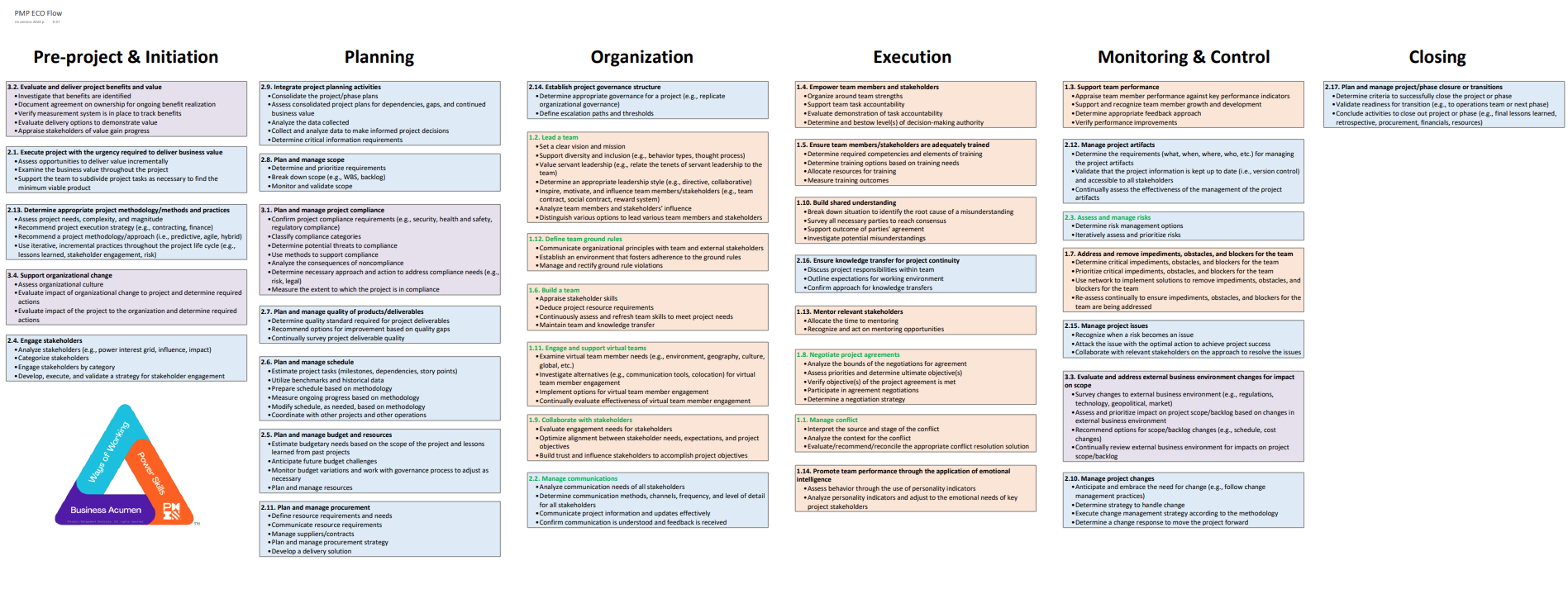
I followed the roadmap shown below because it felt more logical and intuitive to me, especially since it aligns with the familiar project lifecycle stages — from initiation all the way to closing.
First of all, I purchased PMI membershipbecause I didn’t want to rely on “pirated” materials or search for fragmented information all over the internet. At that time, I was still studying for my master’s degree, so I was able to obtain a student membership, which cost around $30 per year. Full membership at that time was approximately $100.
The KnowledgeMap platform itself costs around $10 per month for full functionality with testing, which honestly is almost nothing considering the value it provides. It supports both Ukrainian and English languages, includes a knowledge map, progress tracking, personalized study schedules, and a massive amount of practice tests.
The knowledge map looks like this:
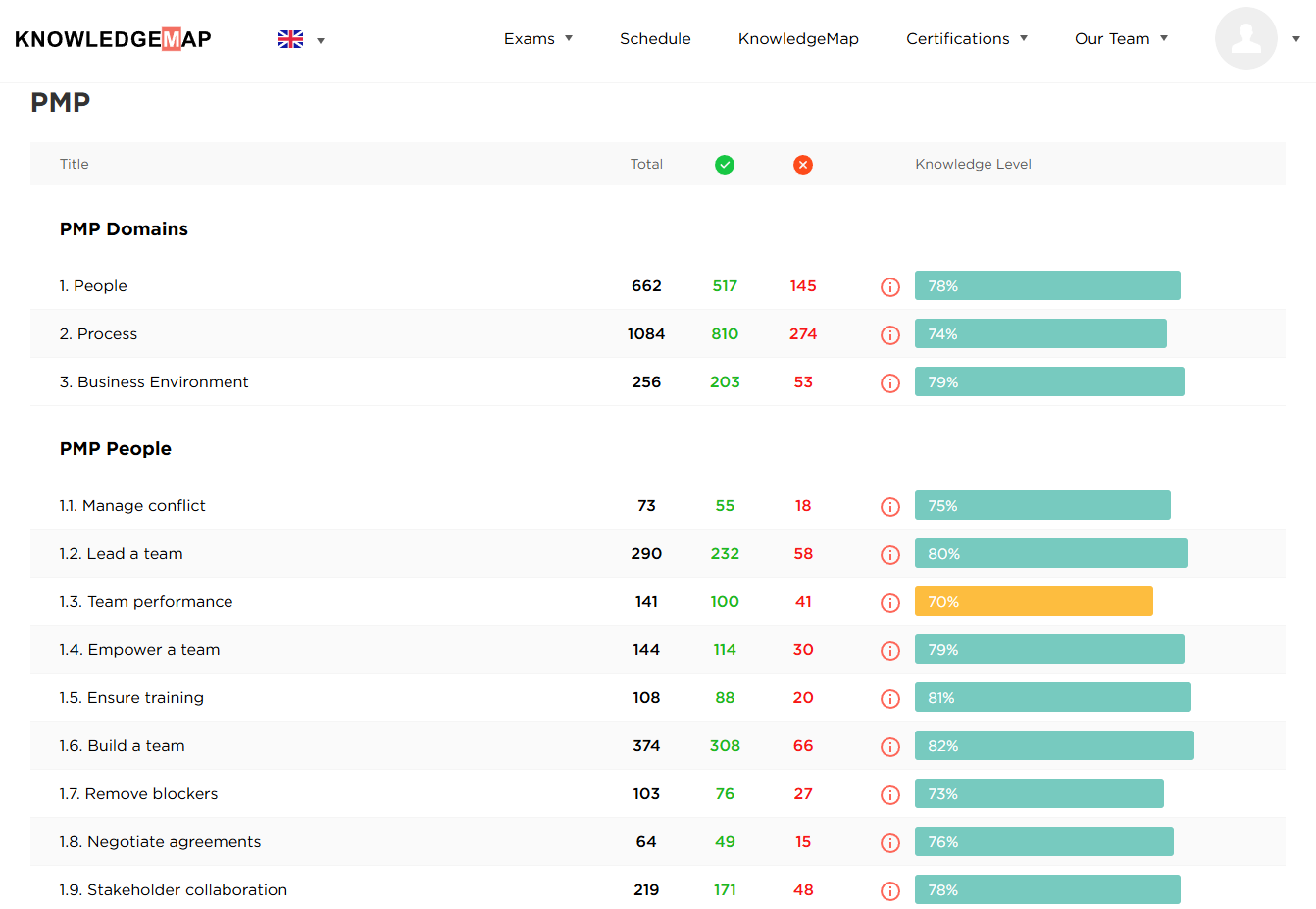
At the beginning, you take an initial assessment test to determine your current level. My score was around 55%, meaning there was still a lot to improve. I also liked the fact that the platform supports preparation not only for PMP, but also for CAPM, PSM, PgMP, PfMP, and several other certifications.
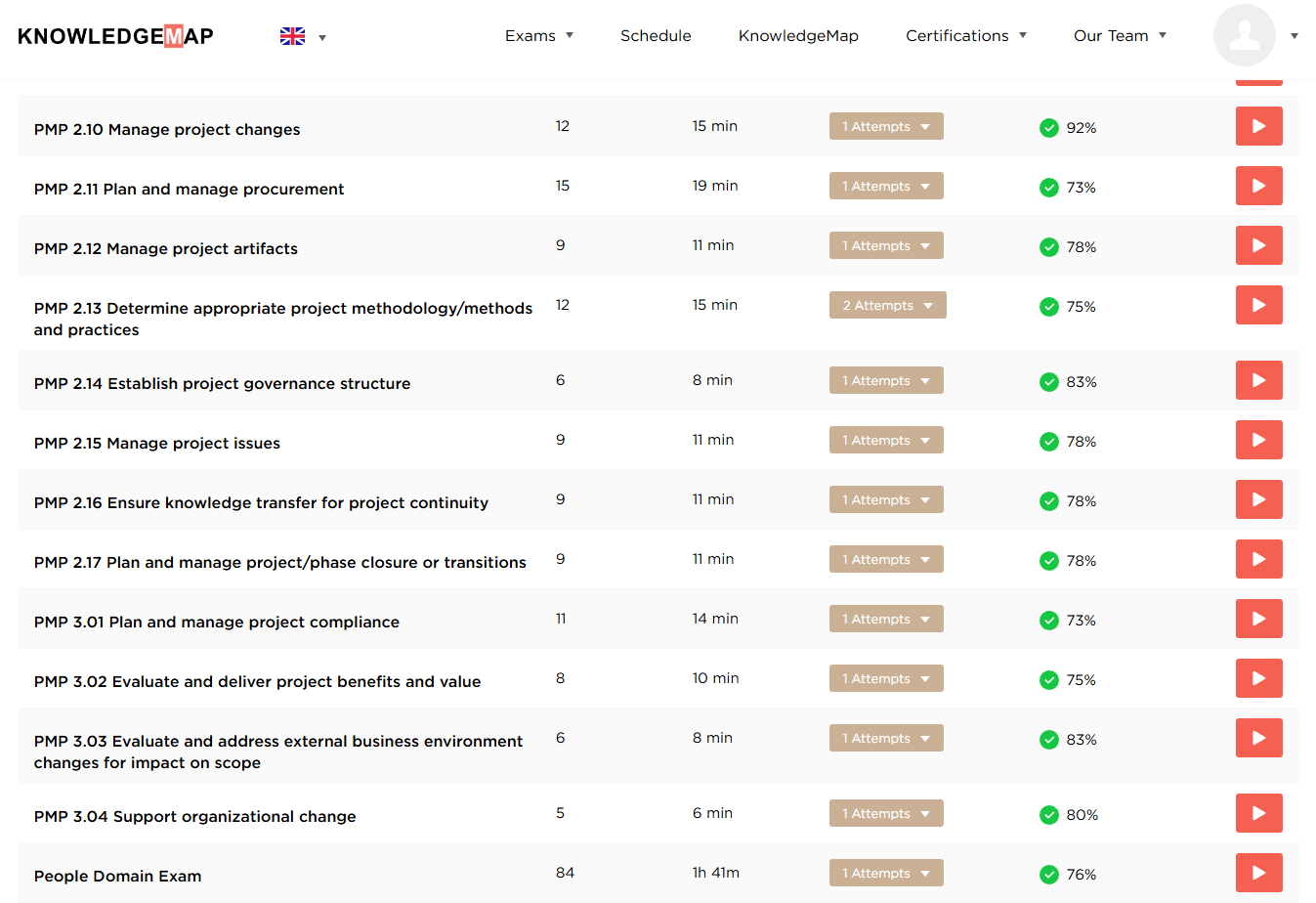
The platform itself recommends continuing practice tests until you consistently score 70% or higher.
How Long the Preparation Took
My preparation lasted a little under a year, but it’s important to clarify that there were long breaks because of my master’s thesis, project deadlines, and a lot of other responsibilities — I think most people know how that goes. I also tried applying many concepts immediately in real practice, which naturally took additional time. And preparation for PMP is far more than just PMBOK theory. I read more than 10 different guides and standards, including practical process group guides, Agile materials, Benefits Realization Management, The Standard for Portfolio Management and other PMI publications.
Objectively speaking, I think allocating around 3–4 months is completely reasonable if you can consistently dedicate at least 2 hours every weekday and another 3–4 hours during weekends. That’s roughly 15–20 hours per week. Interestingly, this also aligns quite closely with what most successful PMP candidates recommend.
After completing the core materials, you receive a certificate for 35 contact hours, which is a mandatory requirement for applying for PMP.

Then you submit your application on the PMI website, pay for the exam, and schedule your test date. After scheduling, I dedicated another two weeks purely to intensive practice testing. I took tests every single day, including weekends.
Besides the platform tests, I also used free resources such as Oliver Lehmann Free Questions and 120 PrepCast Sample Questions. I highly recommend both. There’s also a very useful list of free questions available on ProjectManagement.com .
Many people also recommended PMI Study Hall, saying it’s one of the closest tools to the real exam experience. However, I personally never used it.
The Online Exam Experience
The exam itself cost me $284 with PMI membership. Without membership, it costs roughly twice as much, so the membership practically pays for itself immediately. It’s also important to understand another thing: every exam attempt is paid separately. In total, you have three attempts within one year.
Before paying, you also need to decide whether you’ll take the exam in a certification center or online. I chose the online option through OnVUE. Considering the situation in Ukraine with electricity, internet stability, and general unpredictability, it simply felt safer and more comfortable for me. However, I strongly recommend installing OnVUE a few days before the exam and fully testing everything in advance. And despite doing exactly that, I still experienced technical problems on exam day itself.
On exam day, you need to log in approximately 30 minutes before the scheduled start. Then comes the verification process: your hardware, camera, microphone, and internet are tested; you photograph your room, workspace, and identification documents. Your desk must be completely clear, and nothing suspicious can be nearby.
And then, on the very last step, I encountered problems. Specifically, it happened on a screen that had never appeared during previous system tests. This happened literally minutes before the exam started. There were some strange camera-related issues. I even tried switching from my built-in laptop camera to a mobile one — nothing helped. Meanwhile, the system displayed an A4-sized troubleshooting guide in tiny text. Time was running out, and I genuinely started getting nervous because after the initial registration process, you only have 15 minutes before the exam gets canceled.
Eventually, I fully restarted the program, quickly skipped all previously completed steps — and thankfully, it worked. After that, I waited for the proctor, the person who monitors you online during the exam.
Is Cheating on PMP Actually Possible?
People asked me this, so I’ll answer directly — no, cheating will not work. Don’t even think in that direction. That is actually one of the reasons why PMP certification is so respected globally. To give you an example, at the beginning I simply forgot to remove my watch. By the second question, the proctor had already messaged me in chat telling me to immediately remove it and place it aside. Later, I was asked to rotate my laptop around the room so they could confirm there were no gadgets or additional materials nearby.
The exam itself consists of 180 questions and lasts 230 minutes. After every 60 questions, you can take a 10-minute break. Personally, I had almost no spare time left by the end, although some people say they finish earlier. Overall, including registration, verification, breaks, and the exam itself, the whole process took around five hours.
If you prepared properly and completed many practice tests, the question format eventually becomes familiar. The key is not simply “knowing theory,” but understanding PMI logic and the way they expect you to think in specific situations, because most questions are contextual and scenario-based.
Was It Worth It?
I received my result the next day, although officially PMI allows up to 48 hours. And honestly — yes, it was worth it. Not because of the certificate itself as a piece of paper, but because of the level of structure and systematization that appears after going through the entire preparation process. I genuinely feel that I now look differently at many processes and aspects of project management.
So if I had to summarize it shortly: PMP is not magic, and it’s not a “success button.” But it is an extremely strong systematization of knowledge, an international language of project management, and a very solid test of yourself. And for me, that turned out to be far more valuable than just another line on LinkedIn.